Book For Sale!

Book For Sale!
JUST CLICK ON THE IMAGE TO PURCHASE A COPY!

Search This Blog

Showing posts with label Milton Florida. Show all posts

Sunday, February 12, 2023

Mr. Mapoles, Mr. Pooley, and the FCC


    Clayton Mapoles debuted his new AM radio station WEBY on September 1, 1954. He was a former newspaper publisher in both Crestview and Milton. Initially, the station broadcasted with 1000 watts, but in 1958 the FCC approved an increase to 5000 watts.

    Eventually, near the end of his involvement with WEBY, events on this station’s airwaves changed the broadcast rules for stations nationwide.

    Ben Henry Pooley, who broadcast a morning show on WEBY from 1957 to 1968, showed up for his morning show at about 6 am. He read in the Milton Times a political ad for State Senate candidate, John Boles. In this ad, Boles attacked his opponent, John Broxson for his association with Mapoles when Broxson’s father Bart Broxson had been a political adversary of Mapoles. 

    Pooley was incensed when he saw this. Putting aside his planned editorial for his 6:45 show, he quickly wrote some notes for a reaction to what he just read.

    There is no actual record of what Pooley said on the air. Though he usually would leave a copy of his script to be filed at the station, he was seen folding up his notes and putting them in his pocket as he immediately left the station after his 15-minute show. John Boles, the subject of Pooley’s ire, claimed later that he took notes while listening and he said that he was referred to as “the black sheep of his family”, and even his mother wouldn’t vote for him.

    Boles also later claimed that he called the station and demanded equal time for a response and was refused. A couple of weeks later he filed a complaint with the FCC.

    This was not the first time WEBY, and Pooley was the target of shutdown by their political opponents. In November of 1959, a petition was filed with the FCC by Clifford Wilson, Albert Golden, Richard Finlay, Bart Broxson, Morrison Kimbrough, and Newman Brackin. The petition was for revoking the station license for personal attacks in a political editorial.

    During broadcasts, Pooley would refer to public officials with colorful nicknames such as, “The Bald Eagle from Pollard”, “Super Octane – the Gas-Guzzlin’ Commissioner from Harold”, Little Sir Echo, Prince Albert, and others.

    In May 1959, Pooley had been pulled over on the way to the radio station one morning by two police officers, and two alcohol revenue agents. Searching his car, a container of illegal whiskey was confiscated and Pooley was arrested. A grand jury cleared Pooley of charges and it was believed the booze had been planted.

    Other intimidation tactics included three threats that the station was going to be dynamited unless it stopped criticizing Sheriff Broxson, and removed Pooley from the air. These attempts failed and in November the station was sued for slander by Wilson for $50,000 for claiming he used county gasoline for his private and business vehicles.

    The FCC refused the petition since the station license was not up for renewal at the time.

    Incidentally, a thief stole 4000 records from the station, and a Women’s apparel store Mapoles owned by Milton High School was burglarized. There was an arrest in these cases in May 1961.

    In 1961 when Wilson’s slander case was dismissed, he challenged WEBY’s license renewal. He also lost this challenge. The license was renewed in 1962.

    Through all this process, however, the FCC updated the “Fairness Doctrine” and this along with the later Boles case is now referred to in legal publications as the “Mapoles Decision”.

    So, back to the Boles incident, in July 1967, the FCC voted to designate the license renewal of WEBY for a hearing, after the commission received complaints against the Milton Broadcasting Company, for potential violations of the fairness doctrine for the Pooley editorial broadcast on April 22, 1966. This was due to Boles’ claim that the station would not give him equal time.

    Mapoles attempted to sell the station to Lawrence Hankins Locklin, (aka, singer, Hank Locklin), in early 1968 and terminate the renewal proceeding, but the FCC denied the request.

    During this period Mapoles started claiming poor health to avoid appearing at the hearings. A whole group of doctors including Dr. Rufus Thames, Dr. Enzor, Dr. West from Jay, a doctor from Duke University, and the Rev. Bamburg gave their opinions on the health of Mapoles. Another group of witnesses gave statements alluding to the apparent good health including Albert Golden.

    The hearings concluded with the decision to just renew the license for one year. The FCC Broadcast Bureau disagreed with the decision of the hearing examiner, Herbert Sharfman, and appealed. After oral arguments in Jan 1972, the commission denied renewal for WEBY, who claimed that Mapoles showed an “unpardonable lack of candor” in supplying a purported copy of the editorial that was considerably milder than the one that actually aired and inconsistencies in his medical status. Mapoles appealed allowing the station to remain on the air past the July 3 shutdown date. WEBY finally shut down on March 30, 1973, with much of its programming moving to WXBM-FM.

    There were four known attempts on the life of Ben Henry Pooley. In April 1979, Pooley’s trailer was destroyed by dynamite while he slept. He was lucky to survive due to the blast being absorbed by a closet packed with overcoats, and other clothing. One of his dogs was killed in the blast and the toilet, or bathtub blew through the roof and landed in the yard of the next-door rest home that was owned by Annette Pooley.

    In August 1984, Leroy Johnson was arrested for allegedly participating in a murder-for-hire plot to kill Pooley. This was known as the “ketchup killing”. The FDLE, through an informant, learned of the plot and took Pooley and his family to an undisclosed location. Pictures of Pooley with ketchup on his head were taken to simulate a gunshot wound. The picture was then used as “proof” of the killing. The informant showed the picture to Johnson who then made a trip to Harold. After his return to Milton, he was pulled over by the police, and just under $10,000 was found under his seat. He was taken into custody but died of a heart attack 6 days later. There were no further arrests.

    In September 1987 Chester Cole was sentenced to 35 years for his role in another murder-for-hire plot. Cole was recently paroled and was harboring an escaped convict and convicted murderer named Boo Adams. Adams was supposed to kill Pooley, but backed out and turned the whole thing over to the Sheriff’s department. Chester Cole was on the FBI’s most-wanted list in the early 1960s for armed robberies. Supposedly, Chester Cole was the second choice of the “money man” who wanted Pooley dead. His first choice was William Sanders. Sanders was too sick and died soon after.  Interestingly, Sanders had once been a teacher at Milton High School. He was actually voted “Most Popular Teacher” by the students in 1960. He owned a sporting goods store in Milton, where the downtown parking lot is now, across from the old Florida CafĂ©.

    A fourth and final attempt was made in 1988. It didn’t go very far when the man contracted went to the police instead. Ex-County Commissioner Clifford Wilson of Harold was arrested and ultimately was acquitted at trial in December 1988.

    Pooley returned to the radio in 1991 on WECM 1490-AM.

Pensacola News Journal, 16 Sept 1991


Pensacola News Journal 2 April 1973


Monday, May 8, 2017

The Short Life, and Fast Times of Frank Penton

                Francis Marion “Frank” Penton was the Chief Deputy under Santa Rosa County Sheriff “Long” John Collins.  He killed two men in Milton in two separate shootouts, and possibly a third in an ambush.  The aftermath of his two shootouts saw him cleared by a coroner’s jury. I think if Deputy Penton had lived out west in the 1880s, we would be reading about him along with Earp, and Hickock. 

                On the 14th of February, 1909, at Andy’s Restaurant in Milton, Deputy Penton, and a man named Robert Fleming decided to settle their differences.  Apparently, as soon as they saw each other they drew their weapons and commenced shooting.  Shortly after one pm on that day, Mr. Fleming died of gunshot wounds.  The Coroner’s Jury determined it was justifiable homicide.  It was reported that the shootout was a result of an old grudge. 

                On April 20, 1912, in a downtown Milton poolroom, Frank Penton, and his father, Abner T. Penton, were involved in a gunfight with George Warwick Allen.  Allen was a newly married 24-year-old, and the brother of Minnie Allen Collins, wife of S. G. Collins.  According to newspaper reports, 15-20 shots were fired, and though Frank Penton was wounded, he would recover.  Allen was shot with two different caliber bullets, once in the stomach, and a smaller caliber in the shoulder. Allen had been a witness against Penton in the Felix Corbin shooting. The Pentons were both arrested and later indicted for the murder of Allen.  The elder Penton was found guilty of manslaughter and was sentenced to 4 years in prison.  I have not been able to find any information on the sentence, (if any), for Frank Penton.

                 In early April 1906, George Allen had been tried for the murder of Eubesau Whitmire. On December 3rd 1905, they were quarreling at the L & N railroad depot over luggage owned by a traveling salesman.  Both young men were working as, “Hacks”, or porters for arriving passengers. During the quarrel, Whitmire was shot dead.  Allen was acquitted of the killing. As a possible motive for the gunfight with Penton, Allen had testified against Penton in Penton’s murder trial and was assisting the prosecution against Penton in the Corbin Affair.


The Felix Corbin Affair

                In May of 1910, Felix Corbin fled Emanuel County, Georgia, with a warrant for Assault, and Battery on his head.  Emanuel Co. Sheriff Fields was able to track Corbin to Milton, Florida.  The Sheriff obtained the extradition paperwork and took a trip to Milton.  When Sheriff John Collins received the paperwork, he arrested Mr. Corbin.  Corbin immediately got an attorney to arrange a hearing on the validity of the extradition papers. At the hearing, the papers were declared to be “irregular”, and Corbin was temporarily freed.  Sheriff Fields swore in an affidavit that Corbin was a fugitive from Georgia, and Corbin was again arrested.  Fields, Collins, and Deputy Frank Penton drove Corbin to Brewton, and Fields, with his prisoner, took a train back to Swainsboro, Georgia.

                Once in Georgia, Corbin appeared before the U. S. Commissioner and swore out warrants for the arrest of John H. Collins, Santa Rosa Co. Sheriff, Deputy Frank Penton, also of Santa Rosa Co., and Sheriff Fields of Emanuel Co., Ga.  The charge was depriving Corbin of his constitutional rights by conspiring to take him back to Georgia without extradition papers.

                On June 16th, Collins and Penton were arrested by Federal authorities for forcibly removing Corbin from Florida without a warrant. They were later released. Penton was released on a $300 bond, and Collins on a $1000 bond.  They were to appear in the next  Federal Court session.

                On December 6, 1910, Felix Corbin ate supper with his wife and step-children.  As he finished his meal, he heard someone calling his name outside.  He opened the door and was hit with four bullets. He died quickly, without naming his assailant.  Frank Penton was immediately suspected of the killing. He and a man named W. A. Simmons of Foley, Alabama, were taken into custody.  On Dec. 9, there was a preliminary hearing, and both Penton and Simmons were released with no indictment.  There wasn’t enough evidence to move forward with a case.  The Corbin murder goes unsolved.
 
                (The above description of Corbin's death was reported by the Pensacola Journal. Local Attorney H.S. Laird wrote a letter to the paper complaining about the inaccuracies of the story. He contended that Corbin was boarding at C. F. Clark's and owned no home of his own. He said Corbin was actually shot in the street in front of Clark's store, and that he was only shot twice.)

                By December 22nd, the federal authorities were investigating the murder. Penton Is no longer a Deputy and is in federal custody on two charges: killing Corbin to prevent him from testifying against him, Collins, and Fields, and a charge of conspiracy to commit murder in the Corbin case.

                On April 3, 1911, Penton was indicted by Federal Court but was freed on a $2000 bond.  His trial started later, on December 1.  The Government case was presented by Emmett Wilson, and Penton’s attorney was E. A. Pace of Dothan, Alabama.  On Dec. 3rd, after deliberating for 12 hours, the jury reported that it was hopelessly divided, and the court ordered a mistrial.  When the jury began deliberations, the 10-man jury was 9 for conviction, and one for acquittal.  After 12 hours of debating the issue, it was 6 to 4 for conviction.  Penton was released on the same bond and was to be retried at the next federal court session. 

                In the March 10, 1913 issue of the Times-Democrat newspaper from New Orleans, it was reported that the U. S. Attorney, nol prossed (dropped prosecution), in the Penton and Collins cases.

                One final note on Felix Corbin.  There is a full slab grave marker in the Milton cemetery for Mr. Corbin next to his wife, who died in 1954.  Shortly after his killing, a newspaper in Georgia reported that his body had been shipped back to Georgia to be interred in the Corbin cemetery.  I think he was buried in Milton, and the Georgia newspaper jumped the gun.  Corbin had three sons from his first marriage living in Georgia, with their maternal grandmother. 

                Frank Penton, sometime after being finally cleared of charges in the Corbin and Allen cases, found himself employed as the Chief of Police at the Pensacola Shipbuilding Company.  On June 27, 1919, he was shot and killed by W. P. Cox, who was a subordinate on the police force at the shipyard and shared a dwelling with him. Cox (I think he was Walter P. Cox, born in North Carolina in Oct. 1889, but I'm not 100% sure) and his wife lived in a small house on the shipyard property.  They took in Penton as a boarder, and to all accounts, Cox and Penton were close friends.  Mrs. Cox did not like the domestic situation and moved to the Merchant Hotel and filed for divorce.  Cox hired a Mrs. Maroena as a housekeeper. She had once owned a soft drink stand on West Zaragoza Street.  Penton had been drinking and got into an argument with Mrs. Maroena, who later testified that he "unmercifully misused" her.  She fled to Mr. Cox's room for safety.  A couple of days later, Penton accosted Cox and asked him if he was his friend.  During the conversation, Cox told Penton to go to hell, and Penton pulled a pistol and fired two shots at Cox, missing both.  Cox returned fire and shot Penton in the temple, killing him.  The Coroner's Jury, after hearing testimony, found it to be justifiable homicide.  There was applause when the verdict was announced. 

                Good, or bad, Frank Penton was an interesting character.  I would like to know more about him.  I bet there is much more about his short life that would be of great interest. 

                Mr. Penton is buried in section three of our Milton Cemetery on Berryhill.  His marker claims he died in 1920, but the newspaper claims he was killed in 1919.  Felix Corbin’s marker is in section 12, as is Eubesau Whitmire’s.  George Warwick Allen is buried in the Collins plot also in Section 12. (Northwest part, near the fence).  Allen’s widow, Eva Jernigan, remarried in 1915.  She and her husband, Henry C. Collins, are also buried in the Collins plot.

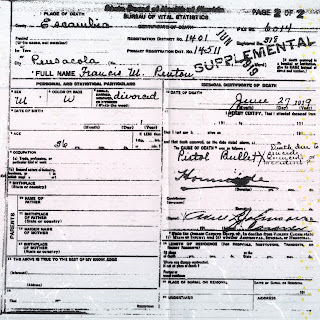
Penton's death certificate shows his occupation as Fire Marshal at Pensacola Shipbuilding Company. He was actually the Shipyards Chief of Police. The certificate shows Homicide by a pistol shot and confirms his date of death as 27 June 1919.

Frank Penton death certificate


Supplemental certificate showing homicide.

Thursday, April 20, 2017

The Fate of Judge Trueman

During the 1931 tragic events in Milton, the attorney and business partner of Spencer G. “Babe” Collins, was a man named Lewis V. Trueman.  In 1933, Trueman departed the Florida Panhandle for new opportunities out west. He and his wife settled in Ogden, Utah, and in 1943, Judge Trueman was killed at night, at his house, in the presence of his wife, with a blast from a shotgun. Amazingly similar to the death of Aubrey Gainer.
Before Gainer was killed, there was an article in the Milton Gazette informing the town that Trueman, his wife and another local couple were going on a trip to Cuba. A few days after they left, on July 18, 1931, Aubrey Gainer was killed outside his home, in the presence of his wife and daughter.  (See previous blog for details)
There was a book written years ago called, “Secrets of the Old Milton Cemetery”, by B. B. Morrell.  In the book Morrell indicated that there was a “Mister X”, who was the puppet master concerning some of the events of 1931.  He didn’t name the person specifically, but my top prospect for that role would be Mr. Trueman.
Babe Collins owned the Collins Construction Company and he built Hwy 37 from Milton to the Alabama state line, south of Brewton.  Of course it is now known as State Highway 87.  His company was to be paid $100,000 for the project.  Bonds were sold by the First National Bank of Milton, and the work was done.  There was a dispute about the money paid to Collins.  He claimed he was owed $15,000, and the Santa Rosa County Commission who  controlled the payout, believed the correct number to be a little over $2,000.  There was a lawsuit and then a change of venue to Walton County.  Unfortunately, Collins was killed before the case went to court.  Trueman, as the lawyer for the estate, settled the case for the $2,000 offered by the county. Incidentally, the only items recovered in the safe after the arson at the ice factory and Collins’ warehouse, were burned remains of road bonds.
During his time in Northwest Florida Trueman had been active in state politics and from 1928 until he left the area in 1933 he was an appointed aide to the Florida Governor Doyle Carlton.  He was also the lawyer for the Santa Rosa Co., school board, and Vice-President and charter member of the Society of the Bar, 1st Judicial District of Florida.
In early 1933, he and his wife Ora, moved to Ogden, Utah, and by January 1939 he was appointed Judge of the 2nd District Court for the State of Utah.


Judge Trueman Grants Divorce to Mrs. Cox

In February 1943 a pregnant Mrs. Wanda May Cox was granted a divorce in Judge Trueman’s court from her drunk and abusive husband, Austin Cox, Jr.  The Cox’s got married in August of 1942 and he was employed at the Utah Naval Depot as a guard.  Soon after marriage, he quit his job, and instead of searching for new employment, he stayed drunk and became very abusive.  He once threatened to cut Wanda’s tongue out. After the divorce Wanda left town and a couple of months later gave birth to a son.  
On the night of July 23, 1943, during Ogden’s annual Pioneer Days Celebration Cox was drinking heavily with friends and around nine o’clock, he received a phone call saying that Wanda was in town and staying at a local address.  He told his friends he was going to see her.

About an hour later Cox drove up to the home of Mr., and Mrs. Bert Stauffer.  When Bert answered the knock on the door Cox demanded that Stauffer, “Send Wanda out here”.  Stauffer didn’t know Wanda and when he told Cox this Cox called him a liar, and threatened him with a shotgun.  Mrs. Stauffer, and her mother, Mrs. Burton came to the door pleading for Cox to leave. Losing his patience, Cox began firing his shotgun.  Mrs. Stauffer and Burton were killed instantly and Bert Stauffer was critically injured but survived his wounds.  A neighbor, Dale Brooks, heard the commotion and ran out of his house to have his hand shot off.  Mrs. Brooks ran into the yard and Cox killed her.  Another neighbor, Sam Nelson was killed as Cox was walking back to his car.

After driving to the home of Judge Trueman, Cox stood in his front yard and fired buckshot into the house.  The Truemans had just gone to bed when they heard the noise and got up to investigate. Ora Trueman later testified that the Judge looked out a window overlooking the yard and after asking what was going on, was hit with a load of buckshot and died instantly. She was unharmed.

Cox eluded the police dragnet until just after midnight when he drove up to the police station.  Lt. John A. Smith, Assistant Provost Marshal of the Ogden area, was there helping to direct the search for the shooter.  He looked up in time to see Cox coming through the door brandishing the shotgun and yelled an alert.  Several officers rushed into the room and one was slightly wounded by Cox. Smith and the other officers subdued Cox with a blow to the head.  During the scuffle, Cox screamed, ‘Why in the hell don’t you shoot me? Come on get it over with!”

In the 1940’s justice was swift.  He was found guilty at trial and sentenced to death.  A higher court delayed his execution for eight months until June 19, 1944.

At dawn, Austin Cox, Jr. was executed by firing squad at the Utah State Prison.  As his death warrant was being read he fought his restraints and stuck his tongue out.

Judge Trueman was buried at Aultorest Memorial Park in Ogden on July 27, 1943.  His wife Ora moved to Pensacola and lived there until her death in October of 1965.

Mostly compiled from numerous articles published in the Ogden Standard-Examiner, 1943-1944.


Tuesday, April 4, 2017

1931 Statewide Pursuit, and Capture of Criminals in Milton


    In March of 1931, four wanted desperadoes on a state-wide crime spree were captured by a posse comprised of police officers and citizens from different Panhandle communities.  After spending the night in hiding in the Mulat swamp, six miles west of Milton, the trapped criminals surrendered to Deputy Sheriff Wade Cobb of Milton, Deputy Alex Cooper of Washington County, and Roscoe Rollins, a civilian from Chipley. 
                The quartet on the run were two men, Leonard “Tex” Hayes, Bert Oglesby, and two women, Fay Harris and Mabel Wertz.  The women were from St. Louis, Missouri, and the men from Oklahoma.
                The crime spree started in Jacksonville on Wednesday night, March 4, when two police officers recognized an Oklahoma license plate reported to be on a car used in a hold-up on Feb. 25th.  Officer Wilbur Blizzard was shot, and patrolman H. V. Branch was clubbed.  The bandits fled to the west and abandoned their car at Lake City.
                Early Thursday morning, they seized a truck in Wellborn, FL, twenty miles west of Lake City, and took two hostages, father and son, D.C., and J. L. McDonald.  They continued westward with their hostages two hundred miles to Chipley.  Officers in Chipley had been forewarned by authorities in Live Oak that the bandits were probably heading their way and were on the lookout for them.
                Nearing Chipley, the bandits were engaged in a gun battle with the local officers, badly wounding Posse man Gillis Malloy and Deputy D. J. Brock, who were later transported to a hospital in Dothan, Alabama.  Both eventually recovered, even though Malloy was hit at least 6 times.  There were also 40 convicts and their guards who were near the shootout and ordered to lie down by the bandits.  The quartet seized a car from a motorist and headed back to the east for seven miles before taking another car, and eventually turning back to the west.  The McDonald's got away from them during the gunfight and were not injured.  One of the male bandits was using a “riot” gun, and one of the women was using a small automatic pistol; Deputy Brock believed (mistakenly) that he had hit her with one shot.
                 Reports were coming in from all over with the bandits being spotted heading to Panama City, Dothan, Alabama, and Pensacola.  Later, it was learned that after taking a car from a motorist, the bandits sped east to Cottondale, turned off on a side road, and went north, then got back on the main road to DeFuniak Springs, where they obtained eight gallons of gasoline and continued on toward Pensacola.
                  
                The bandit car was seen speeding across the Blackwater River bridge into Milton, and the final pursuit began.  Deputy Sheriff Wade Cobb, Mack Williams, and other citizens, including the Mayor of Chipley, R. H. Rollins, and Deputy Alex Cooper from Washington County, gave chase, and the bandits turned off the main road at the Rozier farm, and after three miles on the back road abandoned their car and went into the marsh on foot.  A perimeter was set up, and the bandits spent the night in the swamp.
                Recognizing the hopelessness of their situation, the four surrendered, with Mabel Wertz shouting, “Don’t shoot, we’re coming out!”  As they came out, Hayes made a move like he might be reaching for a gun, but Deputy Cobb had him covered with an automatic rifle.  Wertz had a handbag under her arm and unsuccessfully tried to prevent the deputies from taking it.  Hayes and Oglesby were disarmed, and a rifle was found in the woods.  The only wounds noted on the bandits were a slight cut on Oglesby’s ear, probably caused by a flying piece of glass in the Chipley shoot-out. 
                Santa Rosa County Sheriff Henry Mitchell and Escambia County Sheriff Mose Penton were attending the state Sheriff’s convention at Sarasota.  They drove all night Thursday and arrived in Milton Friday morning.  The prisoners posed for photographs and answered some questions from a Gazette reporter. 
                The prisoners were transported back to Washington County on Friday afternoon and formally charged with highway robbery, assault with intent to murder, and kidnapping. 
                A large crowd had gathered in Chipley when the convoy of three cars arrived, and it was thought that an attempt would be made against the men who had shot and wounded the two Washington County possemen.  There was no attempt.  Sheriff Mitchell and Sheriff Farrior of Washington County appeared in front of the crowd at the courthouse and talked to the assembled crowd.  Sheriff Mitchell described the events and complimented Sheriff Farrior for his assistance, then appealed for the crowd to go home and let the law take its course.  He received a large round of applause.
                By Monday, Sheriff Mitchell received letters and photographs from Tulsa, Oklahoma, Dallas, Texas, and other places.  A detective from Tulsa, Jack Bonham, was particularly interested to know if Mabel Wertz, who was also known as Dammerel, was still with Oglesby.  Bonham said that Wertz was from a nice family in St. Louis, but had married a criminal named Doc Dammerel, who was now serving time in the Oklahoma Penitentiary for highway robbery.  Oglesby was wanted in Oklahoma for escaping from the State Prison.  According to a letter found on Wertz, she was the mother of two children.  The letter was from her mother, begging her to give up her association with Oglesby and come home to the children.
                Hayes and Oglesby had escaped from jail in Springfield, Missouri, by taking a gun from a jailor and forcing him to open the outside door of the jail.  As they escaped, the jailor fired a rifle at the escapees, hitting Hayes and another escapee in the neck, and Oglesby in the shoulder.  Detective Bonham, in his letter, said that Wertz had smuggled in the gun for the jailbreak.  A car that was stolen by the escapees was abandoned in Tulsa, Oklahoma.
                Sheriff Marcel Hendrix of Green County, Springfield, Missouri, was anxious to get Hayes and Oglesby.  They were wanted for numerous robberies in Missouri and Oklahoma, and for breaking out of jail in Springfield on January 27th.   Sheriff Mitchell received the following telegram from the Springfield Sheriff Friday night:  “See you have Burt Oglesby, Tex Hayes, Mabel Dammerel alias Mabel Wertz, and Fay Harris.  I am much interested in the capture of these men as they and four others broke out of jail here January 27th.  One of their partners was recaptured and sentenced to 40 years today, and another got twenty-five years.  If you do not have a strong case I am anxious for these men.  Positive they will receive Ninety-nine here.  Will extradite.”   Sheriff Mitchell informed the Missouri officials that the prisoners had already been turned over to Washington County.
                Hayes and Oglesby were indicted as principals, Wertz and Harris as accessories.  All four pleaded not guilty to the charges in front of Circuit Court Judge C. D. Jones.  State's attorney L. V. McRae said all four would be tried jointly.  None of the four displayed any anxiety over being held for trial.
                On April 2, 1931, after changing their pleas to guilty, Hayes and Oglesby were sentenced to 20 years for robbery and 10 years for assault with intent to commit murder.  The sentences were to run concurrently.  The two women were sentenced to 10 years for being accessories to the robberies and to five years for being accessories to the assaults.  Judge Jones denied the couple's request to be married before sending them to prison.
                At the time of his arrest, Bert Oglesby was on parole from an eight-year sentence for car theft and burglary in Oklahoma.  Governor Murray revoked the parole upon learning of the Florida crime spree.  C.E.B. Culter, pardon and parole attorney, said there would be no attempt to return Oglesby to Oklahoma if he were prosecuted in Florida.
                In October of 1931, Oglesby’s brother Jack, 22, and his sister Zelma M. Woodmansee, attempted to mail arms and ammunition to Oglesby at the prison in Starke, FL.  Mrs. J. Young, Postmistress at Starke, 12 miles from the prison, testified that she had received a package containing two pistols mailed from Tulsa.  Oglesby and Woodmansee pleaded not guilty when arraigned and were released on a $5000 bond.  They were later found guilty and sentenced to prison. 
                The two women, known as the “bobbed-hair bandits”, were paroled from the state prison in Raiford on November 27, 1935.  They were released on December 22nd to the county judge in Tulsa, Oklahoma.  The length of their parole was six months.  They were eligible for a full pardon after their parole was completed.
                Bert Oglesby died in prison of pneumonia and Typhoid on July 2,1932, and his body was shipped back to Tulsa, Oklahoma.  Mabel Wertz Damrell died in Los Angeles, California in March of 1952, and is buried in the same North Hollywood cemetery where Curly Joe of Three Stooges fame, and the wrestler Gorgeous George are buried.  No further information could be found on Tex Hayes or Fay Harris.