Book For Sale!

Book For Sale!
JUST CLICK ON THE IMAGE TO PURCHASE A COPY!

Search This Blog

Sunday, January 22, 2023

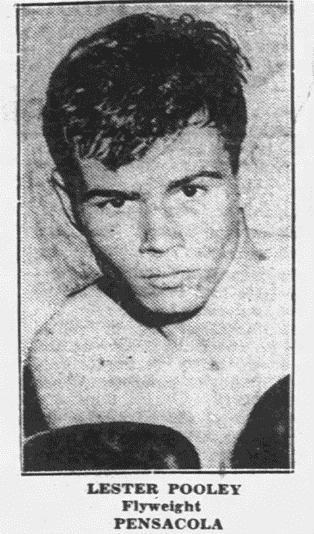
Lester and George

 Lester Pooley and George Wallace

Lester Pooley, older brother of Ben Henry Pooley of Bagdad, Florida had more than 300 pro, and amateur fights. He lost only 9. He fought as a 112-pound flyweight. It was said that he was, “Quick on his legs, fast with his fists.” And “rugged, cunning, and tough.”

In 1935 he won the southeast AAU championship at 16 years old. While still an amateur he would use a false identity to fight professional bouts. The sawmill in Bagdad had shut down so he fought against professionals to support himself.

He defeated Joe Dan Trotman who later became a Judge in DeFuniak Springs. He also knocked out Lew Jenkins, a future lightweight world champ in a Bogalusa, Louisiana fight.

On Feb. 12, 1936 in a Golden Gloves semi-final bout in Nashville, Tenn., he fought future Alabama Governor George C. Wallace and won by unanimous decision.

Many years later at an airport press conference during his presidential campaign Wallace said, “I’m sure glad to see this outpouring of support for my campaign and I’m certainly glad to see my old friend Lester Pooley. You know, Lester whipped me once in a Golden Gloves competition, and he did a pretty good job of it. I’m glad to see he’s on my side now.”

On more than one occasion, Wallace asked Pooley to join his staff as a bodyguard. Pooley always refused. He told the Governor he had a drinking problem, “I might stay sober for a time, but if I took the notion to get juiced-up, I’d do it.” I told him I might help him, but I believe I’d hurt him.

Nov. 30, 1975, Pensacola News-Journal


                                                                          Feb. 23, 1936, Pensacola Journal

Monday, January 9, 2023

Death in a Turnip Field


             Mrs. Estelle Phillips, a 32-year-old mother of six children, was working in a 40-acre turnup field one day near Robertsdale, Alabama in late March 1941, when an airplane swooped down and sliced her head off. The aircraft left a 6-inch-deep furrow in the ground from a wingtip and a small boy was also injured. Later folks in an adjoining field reported that the aircraft had made dives at them too.

            The police were called to the scene and took eyewitness reports and it wasn’t long before their investigation crossed paths with an investigation out of Corry Field in Pensacola concerning a Boeing Stearman trainer aircraft that had returned to base with damage. Two Naval Ensigns who had just recently graduated flight training and were named instructor pilots were taken into custody.

            Ensign Paul C. Brown, from Chicago, who was the pilot that day, and Ensign Joseph C. Thompson, from Healdsburg California, were court-martialed. They were convicted of Involuntary Manslaughter. Brown was sentenced to 24 months, and Thompson got a 12-month sentence. Both were to be served at the prison in Portsmouth, New Hampshire.

            The Federal Government gave $5000 to Mrs. Phillips’s husband and six children for compensation which even though it was 1941, doesn’t seem nearly enough.

            The two culprits in this case only served 5 months and Brown got married four days after he was released in New York City. In a newspaper from December 1942, I found an article saying that Thompson had a job instructing Naval Cadets at Plumas County airport near Beckwith, California.

            Hopefully, Mr. Thompson taught the young cadets about the fatal consequences of childish displays of bravado when your ego outweighs your talent. 


Friday, November 18, 2022

The Killing of 2nd Lt. Allman

     Second Lt. Willis T. Allman was a veteran of the Omaha Beach landing during the D-Day invasion of Normandy. By December 1949, he had served thirteen years in the service. On December 26, while his wife and two sons were in Rocky Mount, NC, visiting her family, Allman was playing shuffleboard at the Oriental Gardens in Norfolk with his friend Lt. Robert Buchanan. They were joined there by a guy they didn't know who was also playing shuffleboard in the club named Michael R. "Buddy" Green. After playing a few games, Green left for a short time, and upon his return to the club, he asked the two if they would take him to another club to play some more shuffleboard. 

    While riding in the backseat, Green produced a revolver and ordered them to pull the car over. He took their wallets with the $4.85 they had between them and made them lie down in a muddy field. Buchanan later testified that he said, "Don't shoot us, Buddy", and Green replied, "Too bad for you because you know my name". With that, Allman lunged at the gunman, and Buchanan ran to find help. He heard two gunshots and, not finding anyone to help, returned to the field and saw Green driving away and Allman with a fatal chest wound. Allman died soon after, and in a very short time, Green was arrested at his home in Ocean View. Ironically, the two victims had no idea Green's nickname was Buddy. It was just what Buchanan used because he didn't know his name. 

    Green was found guilty of murder, with Buchanan returning from his assignment in Korea to testify. He was sentenced to death, but on the eve of his execution, Governor John Battle commuted his sentence to life. The Governor consulted with mental health experts and felt Green was temporarily insane due to his combat experience in WWII.

    Willis T. Allman left a legacy, however. His two sons were Duane and Gregg Allman of the Southern Rock, and Blues band, The Allman Brothers. They had no memory of their father and were raised by their mother, Geraldine Allman. Their father was robbed and murdered by a fellow veteran for $4.85. Sometimes this world just makes no sense. 


Monday, November 7, 2022

The Sad Story of Evelyn Crutchfield


           Evelyn was from Allentown and was the youngest child, and only daughter of Augustus, and Eula Crutchfield. In 1942 when she was 20 years old, World War II was raging and with her desire to help her country she became the first in Santa Rosa County to enlist as a Navy WAVE. (Women Accepted for Volunteer Emergency Service.)

            She completed her primary testing and examinations in Birmingham in October 1942, then went to the University of Indiana in Bloomington for four months of training before assigned to duty as a Storekeeper at NAS Millington, located just northeast of Memphis, Tenn.

            Around 12:30 pm on July 13, 1943 Evelyn was standing near the door of the armory at the Naval Air Tech Training Center, when she was accidently shot by Pfc. Frank L. Richmond. Some newspaper articles I found and her death certificate state it was a machine gun. She received an abdomen wound that severed her spine. She lived long enough to make it to the base hospital, but died soon after.

            I can only imagine the effect her death had on her family. Her body was shipped back home and she was buried on July 16, 1943 at the Calvary Baptist Church Cemetery in Allentown. Two Reverend’s officiated her service, Rev. E.R. Vincent, and Rev. R.G. Key. Her pallbearers were, Jim Leonard, Mac Mclaughlin, Jean Wilson, J.T. Wiggins, Thomas Allen, and Earl Wolfe. Her honorary pallbearers were, Dr. Rufus Thames, Earl Lewis, D.P. McLaughlin, Joe Wilson, Raymond Dozier, L.H. Dondall, E.H. Lundy, Louis Manning, Charles Morris, Cary Phillips, Roy Oglesby, and Joe T. Allen.

            You can tell how well someone is thought of in a community by seeing who was honored by attending them at their funeral. These names are like a “Who’s Who” from the surrounding area.

            I don’t know if Pfc. Richmond was held accountable. I cannot find out if there was any punishment. I also don’t really know what occurred that caused him to discharge a loaded weapon in an unsafe environment.

            In February of 1963 Frank Richmond was working for the Pure Oil Company. He was in Madison, Tennessee scouting locations for future service stations. He was riding in a car with Leon Beard, a real estate salesman, when Beard swerved to avoid hitting a dog. The car crashed into one driven by Mrs. Lola Davenport, 59 who was a secretary for the Guaranty Realty Company. Beard and Davenport survived the crash, but Richmond was dead on arrival. The county Medical Examiner said Richmond died from a broken neck, and fractured skull. At the time of his death his residence was Center Point, Alabama, but he grew up in Memphis.


Evelyn Crutchfield

Thursday, November 3, 2022

Book Release news.

 Hello everybody, 

I'm going to change this blog up a little bit going forward. I will still post some vintage crime stories on here for sure, but also will include other more current news. I published my book a couple of weeks ago and I seem to be getting some good feedback so far. 

I self-published through Lulu.com, and I am pretty satisfied, but I think my next one will be through KDP on Amazon. I've heard good things about it. 


My Book, Not too bad for first effort.

I had an informal, little advertised book signing at our Genealogical Society meeting and sold 5, or 6 books. A few days ago I had a book signing at the Jay Museum during their Halloween festivities, and had a really good turnout. I sold maybe 25, but probably would have been more if I had displayed better. On that note, I have received my posters, and new business cards in the mail today. I'm also thinking about ordering a "sandwich board" type sign for future signings.

Heather, from Heatha Featha barbershop offered to have a book signing there at her shop, and I think I will take her up on that. 
I have had quite a few book orders I filled at home and sent personally, and there have been quite a few orders on Amazon, but I will not know how that is doing for another month or so. 

So, in closing for today, I expect to be much more active on here in the future. I'm still having some health issues, especially with my mobility, but hopefully I will get that fixed soon. Stay tuned....

Lulu Bookstore:


Saturday, September 25, 2021

Death of a Hitchhiker


Ova Budd Roe

            On the afternoon of December 29, 1947, two young men, Glen Williams, and Alex Williams, (Newspaper accounts did not say if they were related), were traveling westbound toward Pensacola on the Gulf Coast Highway. They were traveling from Ft. Walton Beach to Pensacola. When they were about ten miles east of the Pensacola Bay bridge, they saw a body lying off the side of the road in, or near a borrow pit. One article stated that they left to find a phone, and another said they flagged down a passing motorist. Either way they summoned help.

            The first lawman on the scene was Highway Patrolman M.K. Hackle, and soon after, Sheriff Marshall Hayes, Deputy Harvell Enfinger, and County Judge William Bonifay arrived. They called on Dr. Rufus Thames, and he determined the victim had been dead 3 to 4 hours. A teenager named Harold Lowery lived about 300 yards away and he told the investigators that he heard gunshots about one pm, but assumed someone was shooting game. They victim was identified by a bracelet he was wearing, and a tattoo. His name was Ova Budd Roe.

            Some witnesses found later thought the victim was someone who was seen getting into a car with two other men the night before at a roadhouse back toward Pensacola.

            Ova Roe, was a 22-year-old Army veteran who was from Middletown, Ohio. At the time of his death, he was hitchhiking from Denver, Colorado where he had been visiting his brother, to Miami, Florida where he wanted to celebrate the new year. His mother told authorities that he would ship a trunk to his destination, and carry a small case with him. Some reports claimed he was a deserter from the Army, but one claimed he had been a prisoner of war. His mother stated that he kept his discharge papers with him, or shipped them with his trunk.

            Roe had been shot three times, twice in the head, and once in the abdomen. He also had a gash on his head. In a surprising newspaper article, it was published that through ballistic matching, the .32 caliber bullets that killed Roe were fired from the same gun used in two recent unsolved murders in Mississippi.

(I inquired if there were any records left in Santa Rosa County pertaining to the murder investigation, and were assured there were not. I then did a Freedom of Information request with the State, and was informed no records existed.)

            The investigation continued for a while with no solid leads. A toxicologist from Alabama, Dr. Nelson E. Grubbs was brought in to assist, and later he published a newspaper article about four unsolved murders along the Gulf Coast and how they could be solved if only the public would cooperate with authorities. Dr. Grubbs investigated 40,000 cases in this long career with the state of Alabama, and there was even a May 1961 article in Reader’s Digest about him in a “Most Unforgettable Character” story.


The Mississippi Killings

At 4:45 in the morning of December 18, 1947, (eleven days before the Roe killing), the Billups Service Station on Highway 90 in Ocean Springs, Mississippi was robbed of $93. During the robbery, Mark Neal, Jr. was shot four times in the side and died at the scene. E.F. Smith, the station manager, lived in an apartment connected to the station with his wife. He said they heard 3, or 4 shots and a car speed off toward Pascagoula. The station had also been robbed on August 1, of $100. The Billups Petroleum Co. offered a $100 reward for capture and conviction of the robber.

            Mark Neal, Jr. was only in his third week of working at the station. Before that he was a Merchant Seaman working for the War Shipping Administration. He registered for the draft in New Orleans on his 18th birthday in 1946, and it was from New Orleans that he arrived to work in Ocean Springs. His murder is still officially unsolved.

            Robert Lee Ward, a wealthy rancher who lived in Agricola, Miss., near Lucedale, was found murdered in an abandoned pick-up truck three miles north of Pascagoula, on Bayou Cassotte rd. It is believed that he was killed in a home invasion and his body transported to where he was found. He was known to carry around $2000 at all times, and there was no money found on his body. There were suspects arrested who were eventually released, and the case was cold until 1966.

            Roe, Neal, and Ward were the three murders supposedly connected by the same .32 caliber weapon, but I can’t find anything else other than a newspaper article, so it may not be true.

The 1966 developments in the case of R. L. Ward

In July 1966, J.L. Williams was arrested in Marion County, Mississippi for Public Drunkenness. When in jail, he asked to speak to Judge Sebe Dale. The Judge arrived and Williams confessed to the murder of robbery of Mr. Ward back in 1947. He told Judge Dale, “I just can’t get away from that fellow. That bugger has been running me ever since. He gets into bed with me, gets in the truck with me, gets on my shoulder. That’s why I stay drunk.”  In his confession, Williams stated that he and two other men had gone to Ward’s home to rob him, and while he waited outside, the other two were fighting with Ward. Williams said he took a gun, went inside the house, and shot Mr. Ward twice. He was arrested for robbery, and murder. However, on August 25, Williams pleaded innocent to the charges and was sent to the state hospital in Whitfield for psychiatric evaluation to see if he could stand trial. During his confession to Judge Dale, Williams implicated a woman named Alice Ferrill of Biloxi. On July 12 the District Attorney announced he would be filing charges against Ferrill in connection to the Ward murder too.

The D.A. stated in the press that Williams, Ferrill, and another man who was since deceased, had been suspects back in 1948, and Ferrill had been questioned for 28 days. Eventually, all were released due to lack of evidence. No money from the robbery was ever recovered. On September 3, Ferrill pleaded innocent and was released on $5000 bond.

Williams eventually stood trial and he stated that he did not remember talking to Judge Dale, and that he did not willingly, or intentionally waive his right to a lawyer or his right to remain silent. Judge Darwin Maples agreed with him, and ruled his confession inadmissible. The District Attorney, Donald Cumbest appealed Judge Maples decision to the Mississippi Supreme Court, and Williams was released on bond in February, pending the court’s decision.  

In April, Williams was again arrested for threatening the life of D.A. Cumbest. The arresting officer, Howard Ellzey said that on the ride to the Jackson Co., jail, Williams repeatedly threatened his life too. Judge Maples ruled that Williams was to be held without bond pending the outcome of the appeal on the murder case. On Sunday night, August 13, Williams escaped from the jail in Lucedale. He was captured the next day near the city limits and returned to jail. Williams sat in jail until March of 1968 when the Supreme Court upheld his acquittal in the Ward case. Alice Ferrill was to be tried after Williams, but since his confession implicating her was inadmissible, she was never brought to trial.

There was a third person arrested back in 1948 for Ward’s murder. Bruce Thompson, which may have been an alias, was reported to have died before Williams’ 1966 arrest. His role in the crime is not clear. In Williams statement, he claimed he was with two men who went into the house while he waited outside. In any case, Thompson was never prosecuted either.

A further note, there was a fourth murder during this same time period that remains unsolved. Ulysses Lauzon, a Canadian criminal who was on the run from authorities, was found shot to death on the side of Highway 90 near Pascagoula. The 26-year-old armed robber was identified by the New Orleans police department from a 1945 circular from the Ottawa Police. His body was found on July 19, and there were two suspects wanted for questioning. Lauzon had escaped from an Ontario, Canada prison in August of 1947. It is not believed that his murder is connected to the others mentioned earlier.


Well, that’s about it. All these killings with no official conclusion. I would like to know what ballistic evidence, if any, actually connected three of the murders. I feel that Williams was involved in killing Mr. Ward. But, while he was drunkenly confessing, I think he would have spilled the beans about any other murder he was involved in. The gun “could” have been used in more than one crime, but there is little if any chance to determine that at this stage.

I think that Mr. Roe’s parents must have had a strange sense of humor. Ova, is the Latin word for egg, and Roe, is a mass of eggs contained in the ovaries of a female fish. The things we do to our children….

Tuesday, June 8, 2021

The Gainer / Collins Murders

 The Gainer / Collins Murders

Across the road from the L&N Railroad Depot in Milton, Florida was a building complex consisting of an Ice Factory, a general store, and a warehouse with the office of the Collins Construction Company. The buildings were owned by Spencer G. “Babe” Collins with the exception of the Ice Factory which he had recently sold to the Gulf Power Company.

The evening of February 26, 1931 saw a raging fire consume the buildings. The local firefighters were able to heroically contain the damage and the nearby home of the Brashear family was saved. The family was so thankful their home as spared that they publicly thanked the firemen in the local newspaper.

In the ruins of the warehouse, the safe belonging to the Collins Construction Company was found open and emptied with the exception of some fire damaged road bonds. These bonds had been issued by the First National Band for the construction of Highway 37. This road was constructed on an existing road bed from Milton north to the Alabama state line near Dixonville. (It is now Highway 87, and included the construction of a $30,000 bridge.)

Investigation of the burned remains of the building led the authorities to suspect arson. For some reason that is unknown, suspicion fell on the construction company’s bookkeeper, Aubrey Gainer, a well-known and liked 33-year-old from a popular local family. Gainer’s father had recently retired from operating a store on Oak Street near the courthouse. Aubrey was married to Emily (nee’ Carlson), and had an eleven-year-old daughter named Betty. Emily’s parents owned a restaurant in Milton

Spencer Gilbert, (Babe) Collins was possibly the wealthiest man in Milton. His house was the brick home across from the Methodist church on Berryhill. In the 1930 census the house is listed as having a value of $15,000 which was the highest in town. (The church now owns this house.) 

I have read statements in the past claiming that the Collins Construction Company was under investigation for tax evasion by the state of Florida. I also read that Aubrey Gainer was cooperating with the investigation. I haven’t been able to substantiate these claims, but I would like to know more.

Aubrey Gainer was arrested and indicted for the arson. It was claimed that he set the fire to cover shortages in the books of the construction company. Of course, the books were not found and there is no evidence to support the claim. On June 3rd, Gainer was acquitted of arson in the Circuit Court. He must have known by now that his cooperation with the authorities in the tax case was no secret and began making moves to get out of Santa Rosa County. He bought a $50,000 life insurance policy and he invested money in some drug stores in Crestview, Okaloosa County. He waited too long to make his move.


 On June 14, 1931 with great fanfare, and loads of visiting dignitaries, the bridge across Santa Rosa Sound opened allowing vehicles with up to four passengers to pay one dollar to drive across the sound to Casino beach. An excess of four in the car paid 10 cents a head for the overage.

On July 18th Aubrey Gainer, wife Emily, daughter Betty, and Betty’s friend Myrtle Mitchell, the Santa Rosa County Sheriff’s 11-year-old sister, piled into the Gainer car for an excursion to check out the new bridge. An outing such as this in 1931 must have been quite exciting to the young ladies, and Aubrey surely needed a break from the pressure he must have been under. (I wish I knew what kind of car he owned.)

Around 10 pm, or so, the weary sightseers returned to Milton, and after dropping Miss Mitchell off at the Sheriff's office, made their way to their home on Pine Street. The Gainer home was on the corner of Pine, and Escambia with a separate garage located behind the house with its entrance off of Escambia Street. About 300 feet due south of the garage was Hill Street and then the L & N railroad tracks.  (These parts of Escambia, and Pike streets no longer exists.)

Aubrey dropped Emily, and Betty off before he turned into the garage, and they moved into the yard to await Aubrey to walk to the house. Gainer parked the car, exited the garage and taking Betty by the hand started to walk to the house. Then, suddenly a shadow appeared from behind the garage and fired a shotgun directly into Aubrey’s torso. As he fell, he pulled Betty down with him. The gunman disappeared into the night as Emily, and Betty screamed for help. The neighbors heard the commotion and called Sheriff Mitchell. The Sheriff and Chief Deputy Wade Cobb arrived at the scene, and though it looked bleak, Gainer was still alive and they arranged transportation to a hospital in Pensacola where he died early the next morning. The attending physician said Gainer was hit with nine pellets, six of which passed all the way through his body, and three were removed.

The home of the Gainers
From the 1917 Sanborn Fire Insurance Map of Milton


Sheriff Henry Clay Mitchell had already been the top law enforcement officer in Santa Rosa County for ten years. He was only 25 when elected and was the youngest Sheriff in the nation when he took office. His Chief Deputy Wade Cobb would also one day be a two-term Sheriff of the county. They examined the crime scene at daylight and found some interesting clues. About 150 feet or so from the garage they found a shotgun tossed in some bushes and footprints led into a swampy area and then some tire marks consisting of three different tread patterns that a parked car had left in the soft soil.

There was an arrest made almost instantly. H. R. Covington, a sailor from Oklahoma, but assigned to Pensacola was taken into custody but no charges were filed. He was released on July 23, after Sheriff Mitchell made two more arrests, and was convinced he had the murderers. Two days after the ambush, and killing, William T. Wolfe, and Webb Allen were taken into custody and charged with murder. Webb Allen was the nephew of S. G. Collins’ wife Minnie.

Sheriff Mitchell talked to many potential witnesses during his investigation. Some witnesses told him they had seen Wolfe, and Allen in a car the night of the murder. The suspects denied even being in town that night. Wolfe lived about 15 miles or so north of Milton. The Sheriff did not believe them and examined the car they were in. The suspect car had three different types of tires with three different kinds of tread. The distinctive tread matched perfectly the tread marks found near the crime scene. Then came the revelation that the shotgun discarded in the bushes was bought a few months later from a dealer in Pensacola by S.G. Collins. He had reported it missing from his company office a short time before the crime.

When Gainer was murdered S. G. Collins was out of town. He left during the first week of July on a trip to North Carolina to drum up some business for his construction company. Also, his lawyer Lewis V. Trueman was on a trip to Cuba with his wife, and another couple. Trueman had an article about their upcoming trip printed in the Milton Gazette.

Wolfe, and Allen were held on a $25,000 bond which they could not post. Collins returned to Milton and posted a $25,000 bond. He was suspected of being an accessory before the fact. Namely, hiring the killers to silence Gainer. Wolfe, and Allen appealed their bond by filing a writ of habeas corpus with the Florida Supreme Court. Even though Sheriff Mitchell was sure that William Wolfe was the triggerman, and Webb Allen was the driver, Wolfe was set free, and Allen’s bond was reduced to $5000. Within a week he was able to raise the money and was also set free.

William Wolfe needs to be discussed a little. There is no way at this late date to know for sure, and he was never convicted of any violent crime that I have been able to find. However, in 1911 he was a convict guard at a turpentine camp near McLellan and Leon Rivenbark was his brother-in-law and fellow guard. George Rivenbark was a “woods rider” for the Franklin Gaye camp. These were some hard men. George Rivenbark administered a beating to Jonas Cooley, and when his brother Daniel Cooley came riding into the camp a few days later, he was killed by Franklin Gaye. Three days later Arch, and Alf Cooley were killed near the steel bridge on the Milton-Munson road. They were shot from ambush, and their killing was never officially solved. Hyman Cooley was sure he knew who had done the killing and a couple of years later, he saw Leon Rivenbark and shot at him. He missed and when Leon returned fire he didn’t. An inquest ruled it was self-defense. (See, “The Turpentine Feud of 1911”).  Also, a few years ago, an older citizen of Santa Rosa County told me that when he was a younger man in the late 1930’s and into the 40’s and 50’s it was known that Mr. Wolfe was a man that did not mind getting his hands dirty.

I would also imagine that Sheriff Mitchell was especially motivated to find, convict, and punish the Gainer killers because his young sister Myrtle, and Betty Gainer were best friends, and possibly she could have been there in the line of fire if she had gone home with Betty.

Santa Rosa county had a small law enforcement presence. A Sheriff, and Chief Deputy; maybe another deputy, and some constables scattered in different communities. During this same period in 1931 there were numerous other serious crimes. Ben Lee shot Dempsey Enfinger in a dispute over a young lady. Another young lady named Lilla Yarler shot Tom Harvell. A man named Will Cooley was killed by J.G., and Lee Thomas, brothers from Bagdad, and his body dumped in the Yellow River. Cooley’s wife was also implicated in the murder. A tenet farmer named George Ellis had a dispute with the man he farmed for over two bales of cotton, and he shot and killed R.G. Quick in the Berrydale area. Also, it was the year that a posse cornered 4 desperadoes in Mulat Bayou who were on a statewide crime spree. I’d say the Sheriff’s office had its hands full. 

Aubrey Gainer's father J.C. was a retired store owner and maybe the grief was just too much. He died suddenly on August 31. 


Spencer G. “Babe” Collins was still under bond on September 11, when he traveled across the bridge to the east Milton home of his business partner, and friend J. E. Estes. He was there to discuss some of the business he was able to obtain on his trip to North Carolina. The investigation of Aubrey Gainer’s murder had stalled, and Collins was probably trying to put it all behind him and get back to business.

It was right around dusk when he and Estes finished their conversation and Collins walked across the road toward his car to head back into town. Estes had turned to walk back to his house when a slow-moving car, later thought to be a Ford Model A when described by witnesses, approached Collins. As it neared him, someone fired a shotgun mortally wounding Collins. Estes rushed to his aid, and Collins told him, “Get their number! Call the doctor, they got me.” Estes looked at the car as it crossed the bayou bridge, but he could not make out the license number.

A truck carrying three men, G.L. Metts, John F. Collinsworth, and Posey Broxson arrived on the scene. Dr. J. B. Turner, and Dr. Rufus Thames arrived quickly and tried to find a pulse. They pronounced Collins dead on the scene. Sheriff Mitchell then arrived and questioned the witnesses. There were some men working close by who had heard the shot, but did not see anything other than identifying the type of car.

Collins had been hit in the shoulder with double-ought buckshot with the 12 pellets ranging down through his body and shredding his heart. He died right after his last words to his friend Estes.

A young man named Almon Spencer was in front of the Imogene Theater when he heard the shotgun blast from across the river. As he watched the bridge a car with three men he recognized came across and turned immediately. Almost eight decades later one of his younger brothers told me that the men in the car were, Chief Deputy Wade Cobb, C.B. Penton, and a man named Villar. I also heard from someone who knew Cobb that around 1960 when he was running for Sheriff, he expressed concern that he would not be elected because too many people knew about his involvement in the Collins killing. It is also interesting to note that within two years, the lawyer for Collins, L.V. Trueman moved to Ogden, Utah and was there until he was killed at his home by someone he ruled against in a divorce case. (Read about that case, here.)

Sheriff Mitchell summoned Judge McLeod who acted as coroner, and they impaneled a jury consisting of Dick Lane, G.C. Beck, G.L. Metts, Posey Broxson, Gully McCombs, and J.E. Estes. The Sheriff questioned the men who were working nearby. They were T.R. Scruggs, owner of Scruggs Boatworks, M.N. Diden, Dewey Batson, and John S. Cox. They told him they heard the blast, but thought it was a blow out. They did not see a license plate, but agreed that it was probably a Ford Model A.

If, (a big IF), Deputy Wade Cobb was involved, then Mitchell probably knew what was going on and questioned the witnesses closely at the inquest to see if anyone had seen anything important.

The death of Collins pretty much ended the investigation into the Gainer murder. Will Wolfe, and Webb Allen were never tried and it became a cold case. There was an arrest, and trial in the killing of S. G. Collins however.

Collins older brother, John Houston Collins, known as Long John due to his 6 ft., 7-inch height was well known and respected in Northwest Florida. He had been Sheriff of Santa Rosa County on two separate occasions. He was also an ex-mayor of Milton, and at one time was Postmaster. He was not going to be easily satisfied about the progress of the investigation into his brother’s murder. His investigation, and relationship with prison officials at Raiford ended up with Cecil B. Penton being arrested and tried for the murder of Babe Collins in 1934. My essay about his arrest and trial is linked here.

Author’s note:  I debated about sharing the possible involvement of Deputy Wade Cobb. I finally decided it should be included. I mean no disrespect toward a man who I consider to be a fine Sheriff and served this county well during his career in law enforcement. I can even understand why Sheriff Mitchell and Cobb would have taken things to this extreme. It was a different time, and Mitchell probably felt his main suspect was going to get away with it due to his great wealth and standing in the county. Mitchell was defeated in his reelection bid by Joe Allen. Possibly because he didn’t solve this case, or more likely due to the fact he was suing the County Commission for not reimbursing him properly for jail, and prisoner upkeep. Mitchell went on to a long career in different official state roles involving law enforcement. He even unsuccessfully ran for Escambia County Sheriff later in life.

If you haven’t visited my blog yet, please do so. You might find other stories of this type that will interest you. I hope you like it, and please leave comments either there, or on the Facebook Group. These stories are all works in progress, and if I learn any new or different information, I always update, and correct.

  http://judgingshadows.blogspot.com/